- Editorial Expertise: Men's Health, Healthy Aging, Nutritional Supplements, Evidence-Based Wellness
You used to be able to eat whatever, whenever, and feel fine an hour later. Now a normal meal leaves you bloated for the rest of the afternoon. Things move slower. Some days your stomach looks and feels visibly swollen by 3 PM, and you didn't even eat that much.
Most men chalk this up to "getting older" and move on. But there's an actual, measurable reason your gut doesn't work the way it used to — and it's not just about what you ate.
What's Actually Changing in Your Gut After 40
Three things shift at roughly the same time, and they compound each other.
Digestive enzyme production declines. Your body's output of the enzymes that break down food peaks in your 20s and gradually drops from there. Less enzyme activity means food sits in your gut longer before it's fully broken down — which is a big part of why meals that never used to bother you now leave you bloated.
Gut microbiome diversity drops. Research on aging and the gut microbiome consistently shows that microbial diversity — the range of different bacterial species in your gut — tends to decrease starting in this decade of life. A less diverse microbiome is associated with more gas production, more irregular bowel movements, and a gut that's generally less efficient at processing food.
Declining testosterone affects gut motility. This one surprises most men. Testosterone doesn't just affect muscle and libido — it plays a role in smooth muscle function throughout the body, including the muscles that move food through your digestive tract. As testosterone gradually declines after 40, that "gut motility" can slow down too, contributing to the sluggish, backed-up feeling a lot of men describe.
Put together: less enzyme power, a thinner microbiome, and slower gut motility. That's not a personal failing or "just getting older" in some vague sense — it's three specific, documented mechanisms working against you at the same time.
What Actually Helps (Independent of Any Product)
Before getting into any supplement, here's what the research actually supports for gut health after 40:
- Fiber, consistently. Most men don't get close to the recommended 30-38g/day. Fiber feeds the beneficial bacteria that are already declining in diversity — it's the single most evidence-backed lever for gut health at any age.
- Chewing and eating pace. Digestion starts in the mouth. Eating fast and under-chewing puts more burden on an enzyme system that's already producing less than it used to.
- Hydration. Low water intake is one of the most common, most fixable contributors to slow transit time and bloating.
- Stress management. The gut-brain connection is well-documented — chronic stress measurably slows digestion and alters gut bacteria composition.
- Probiotic and prebiotic foods or supplements, broadly, have real (though strain-dependent) evidence for supporting microbiome diversity.
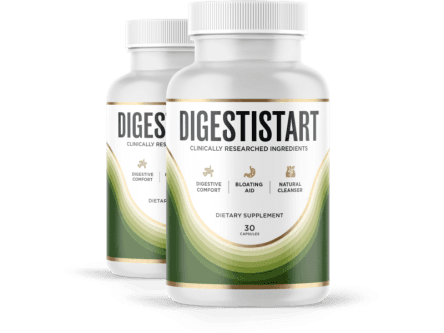
DigestiStart
DigestiStart
A digestive support formula built around 11 traditional herbal ingredients, designed to support gut comfort and regularity.
What's Actually in DigestiStart
DigestiStart is a capsule supplement built around a proprietary blend of 11 herbal ingredients, most of them staples of traditional Chinese medicine (TCM):
- Wild Yam
- Rehmanniae Radix
- Dodder Seed
- Eucommia Ulmoides
- Poria Cocos
- Radix Achyranthis
- Cistanche
- Polygala Tenuifolia
- Schisandra
- Shan Zhu Yu
- Cnidium Monnieri
Honest disclosure before you buy: the sales page's core explanation for bloating — that it's caused by "gut paralysis" from lead exposure in canned food and modern packaging — is not an established medical concept. Lead exposure is a real toxicological concern, but "gut paralysis" as a mechanism for everyday bloating isn't something you'll find in the digestive health literature. Treat that specific claim as marketing framing, not science.
On the ingredients themselves: several of these herbs — particularly Poria Cocos (a fungus with polysaccharides studied for prebiotic-like effects) and Schisandra (studied mainly for liver protection, with some traditional use for digestive "qi") — have a real history of traditional use tied to digestion. But most of this list (Rehmanniae, Dodder Seed, Eucommia, Cistanche, Cnidium Monnieri) is more commonly associated in TCM with kidney function, bone health, and vitality than with targeted digestive support specifically. There is no published clinical trial on DigestiStart's complete formula for bloating, IBS, or microbiome health — the evidence here is traditional-use and ingredient-level, not a trial on the product itself. Also worth noting: despite third-party summaries describing this product as containing "enzymes and probiotics," the official ingredient list is 11 herbal extracts — no digestive enzymes or probiotic bacterial strains are actually listed.
None of that means it can't help — traditional-use herbs aren't automatically ineffective, and individual response varies. It means the claims on the sales page are stronger than what the current evidence supports, and you should go in with that context.
🔍 Quick Verdict: DigestiStart is a proprietary blend of 11 traditional Chinese herbs, manufactured in a GMP-certified, FDA-registered U.S. facility. Despite the "digestive comfort" branding, most of those herbs (Rehmanniae Radix, Dodder Seed, Eucommia, Cistanche, Cnidium Monnieri) are traditionally used for kidney function and general vitality, not digestion specifically — only Poria Cocos and Schisandra have a real traditional tie to gut and liver health. There's no clinical trial on the finished formula, and despite third-party descriptions, it contains no digestive enzymes or probiotic strains. The 60-day guarantee limits the downside of trying it, but fiber, hydration, and stress management (all covered above, all free) will likely move the needle more than this supplement alone.
Check DigestiStart Pricing →
Pricing and Guarantee
- 2 Bottles: $79 + $9.99 shipping
- 2+1 Bottles (Most Popular): $69/bottle, free shipping
- 3+3 Bottles (Best Value): $49/bottle, free shipping, plus 3 bonus guides
Every order is backed by a 60-day money-back guarantee.
DigestiStart
Pros
- • Manufactured in a GMP-certified, FDA-registered U.S. facility, non-GMO
- • Poria Cocos and Schisandra do have a real traditional-use tie to digestive and liver support
- • 60-day money-back guarantee, even on used bottles
- • One-time purchase, no subscription or hidden charges
Cons
- • Most of the 11 herbs (Rehmanniae Radix, Dodder Seed, Eucommia, Cistanche, Cnidium Monnieri) are traditionally used for kidney function and vitality, not digestion
- • No clinical trial on the finished formula for bloating, IBS, or gut health
- • Despite the marketing description, contains no digestive enzymes or probiotic strains
- • Sales page's 'gut paralysis from lead exposure' explanation for bloating is not an established medical concept
The Verdict
DigestiStart's biggest issue isn't manufacturing quality — it's a mismatch between the 'digestive comfort' framing and the actual formula, which leans heavily on traditional Chinese kidney-tonic herbs rather than a targeted digestion blend. Poria Cocos and Schisandra have a real tie to gut and liver health; most of the other nine ingredients don't. If persistent bloating is the problem, fix fiber and hydration first — treat DigestiStart as a low-risk, low-certainty addition backed mainly by the refund guarantee, not by trial data.
🔒 Official Vendor Site
Considering DigestiStart?
If bloating and slow digestion are dragging you down after 40, DigestiStart is one option built around traditional herbal ingredients — with a 60-day guarantee that limits your downside if it's not for you. Go in knowing what the evidence does and doesn't say about the formula.
Check Current Pricing →
Frequently Asked Questions (FAQ)
Is bloating after 40 normal, or should I see a doctor? Occasional bloating tied to certain foods is common and usually not a concern. But new, persistent bloating — especially with pain, weight loss, blood in stool, or a major change in bowel habits — should be evaluated by a doctor before you assume it's just aging. Those symptoms can overlap with conditions that need real diagnosis.
What's the fastest thing I can change without buying anything? Fiber and hydration, in that order. Most men are meaningfully under both, and both have strong independent evidence for gut health.
Does DigestiStart contain probiotics or digestive enzymes? Based on the official ingredient list, no — it's 11 herbal extracts, not a probiotic or enzyme formula, despite some third-party descriptions suggesting otherwise.
How long before I'd notice a difference? The product's own marketing suggests days to weeks for some users, but there's no clinical trial on the full formula to point to for a real timeline. If you try it, pair it with the fiber/hydration/stress basics above rather than expecting the supplement to do all the work.
Scientific References
- Vaiserman, A., et al. (2020). "Gut microbiota: a player in aging and a target for anti-aging intervention." Ageing Research Reviews. — On declining microbiome diversity with age.
- Salles, N. (2007). "Basic mechanisms of the aging gastrointestinal tract." Digestive Diseases. — On declining digestive enzyme output with age.
- Traish, A. M. (2014). "Testosterone and weight loss: the evidence." Current Opinion in Endocrinology, Diabetes and Obesity. — On testosterone's broader role in smooth muscle and metabolic function.
- Giannetti, E., et al. (2017). "Probiotics and prebiotics for functional gastrointestinal disorders." Current Opinion in Gastroenterology. — On evidence for probiotics/prebiotics in gut health.
- Wang, Y., et al. (2020). "Polysaccharides from Poria cocos: extraction, structure, and bioactivities." International Journal of Biological Macromolecules. — On the prebiotic-like properties of Poria Cocos.
Continue Reading
Not Sure This Is the Right Fit?
Every man's situation is different. Answer two quick questions and we'll point you to the one product on our list built for your specific concern.
What is bothering you most right now?
Have a partner interested in women's health? Visit our sister site, HerVitalityGuide.